
The Science Behind the Cricket Racquet
How strung strings store and return impact energy more efficiently than a solid bat — with cited research.
The Cricket Racquet borrows a principle from tennis: when a ball strikes a strung surface, both the ball and the strings deform. The strings stretch, temporarily storing elastic energy, then recover while the ball is still in contact — returning energy to the ball that a solid surface would lose.
Tennis strings vs. a solid wooden bat
| During impact | Tennis racquet strings | Solid wooden bat |
|---|---|---|
| What deforms? | Both the ball and the string bed | Mainly the ball locally, with some bat deformation |
| Where is energy stored? | In stretched strings and the compressed ball | Mainly in the compressed ball, plus bat bending and vibration |
| What helps the rebound? | Strings spring back while the ball is still touching them | Ball recovery and the bat's effective mass and speed |
| What wastes energy? | Ball deformation, frame vibration, friction and recoil | Ball deformation, bat vibration and recoil |
| Key advantage | Strings return ~95% of their stored elastic energy | No string bed — energy stays in the ball and bat |
How tennis strings store and return energy
When a tennis ball strikes a racquet, both the ball and the string bed deform. The strings stretch, temporarily storing elastic energy, then recover while the ball is still in contact with them. Laboratory research by Cross, Lindsey and Andruczyk tested 90 tennis strings and found that energy losses within the strings were small. String stiffness influences how impact deformation is shared between the strings and the ball. Allowing the strings to absorb more deformation can reduce energy lost through compression of the ball.
How this compares with a solid bat
A traditional solid wooden bat does not have a suspended string bed. The ball compresses against its surface, while some collision energy also enters bat bending, vibration and recoil. The final rebound depends on the ball's properties, impact location, bat speed and effective mass. Rod Cross's explanation of ball–bat physics states that tennis strings return approximately 95% of the elastic energy stored in them — but this figure describes the strings' stored energy, not the total impact energy transferred to the outgoing ball.
Where the energy is lost — the same tennis ball
When a racquet and a solid cricket bat both strike the same tennis ball, the difference is where the collision energy ends up. The strings absorb the impact and return most of it; a rigid bat forces the ball to do all the deforming, wasting energy as heat inside the ball.
| Where energy is lost | Tennis racquet + tennis ball | Cricket bat + tennis ball |
|---|---|---|
| Ball deformation (heat) | Low — the string bed deforms first, sparing the ball | High — the rigid willow forces the ball to squash, wasting energy as heat |
| Implement deformation | Very low — strings return ~90–95% of stored elastic energy | Negligible — willow barely flexes under a light tennis ball |
| Frame & handle vibration | Low to medium — damped by the flexible frame and string bed | Medium to high — energy lost vibrating the blade and handle |
| Sound | Minimal — a brief 'pop' | Higher — a broader 'thwack' |
| Total energy lost | Roughly 15–25% | Roughly 45–55% |
The biggest difference is inside the ball. A tennis ball is hollow and pressurised; when it deforms, its rubber core rubs against itself and turns kinetic energy into heat. Against a racquet the string bed yields first, so the ball is spared from flattening completely. Against a solid bat the rigid willow won't give — so the ball is forced to do all the flexing.
Strings are efficient springs: they stretch, store energy and snap most of it cleanly back into the ball. Wood has almost no trampoline effect, so any energy that flexes the bat is lost as internal damping rather than returned to the ball.
Miss the sweet spot and the story changes. Off-centre hits send bending vibrations up the frame or blade — energy that should have gone into the ball's exit speed instead reaches your hands as a sting.
Why a lighter bat helps children learn
A child's bat should match their size, strength and stage of development. Research in youth baseball found that lighter bats were the optimal tested option for most young players, with benefits including faster bat rotation and shorter swing times.
Cricket research also shows that modifying equipment can help young beginners demonstrate more desirable batting technique. Across children's sports, scaled equipment is linked to better skill performance and more effective movement patterns, with some evidence of faster learning.
Balance matters as much as weight: one youth study measured rotational inertia — how hard the bat is to accelerate around the hands — and found the best bat varied with the child, rather than 'the lighter, the better' for every player.
An appropriately light, well-balanced bat can help create favourable conditions for practice and build a stronger batting foundation. Long-term success also depends on coaching, practice, physical development and continued participation.
The trampoline effect in hollow bats
Hollow baseball and softball bats can produce a related trampoline effect. where the barrel deforms during impact and returns some stored energy to the ball. Research by Nathan, Russell and Smith explains how this can increase the coefficient of restitution — the relative rebound speed compared with the relative approach speed.
Why a replaceable foot matters
A replaceable foot extends the life of the bat and lets players tune swing weight and balance to their own game. The foot is the part that wears fastest because it contacts the ground on every setup — making it serviceable turns a wear item into an upgrade path rather than a reason to replace the whole bat.
Tune your strings to your game
String tension changes how the string bed responds when it meets the ball. Lower tension generally allows greater string-bed deflection and can increase rebound speed, while higher tension creates a firmer response and can help some players manage shot trajectory and depth.
Research under playing conditions found greater average ball speed at lower tension, alongside more shots landing long. Higher tension produced more net errors. Other research shows that the lowest tension does not necessarily produce the fastest shots, and an intermediate tension can provide a better combination of speed and control.
The aim is to find a setting that suits the player's swing, timing and preferred feel. Adjustments should remain within the frame manufacturer's approved tension range.
Fibreglass vs. carbon-fibre
Our fibreglass version carries a lower string tension than the carbon-fibre model, which supports a higher approved tension range. Lower tension favours power; higher tension favours control — so the racquet's strings can be tuned by tension to whether the player prefers power or control.
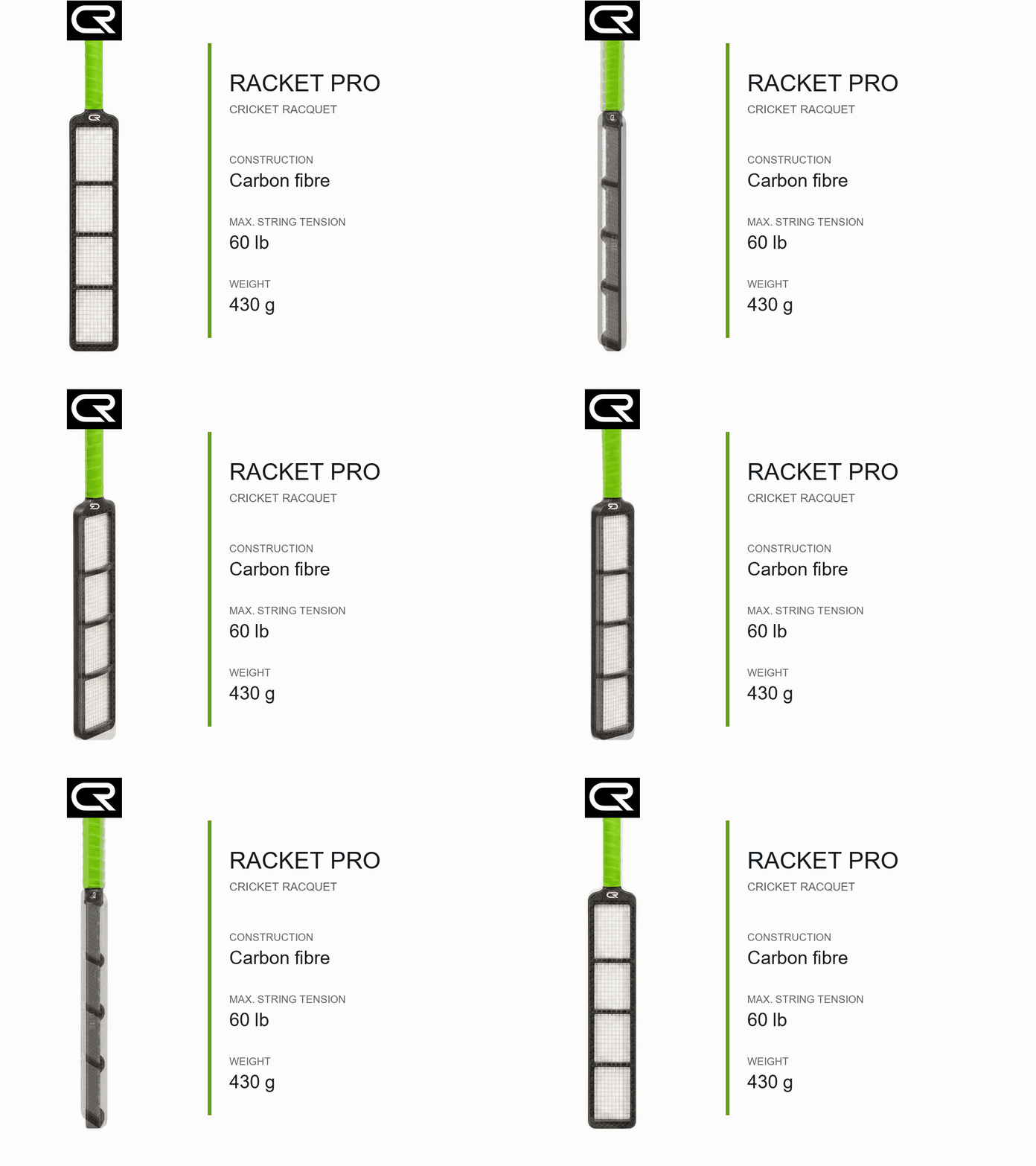
Cricket Racquet Pro
Carbon Fibre · 430g · 60 Lbs max tension
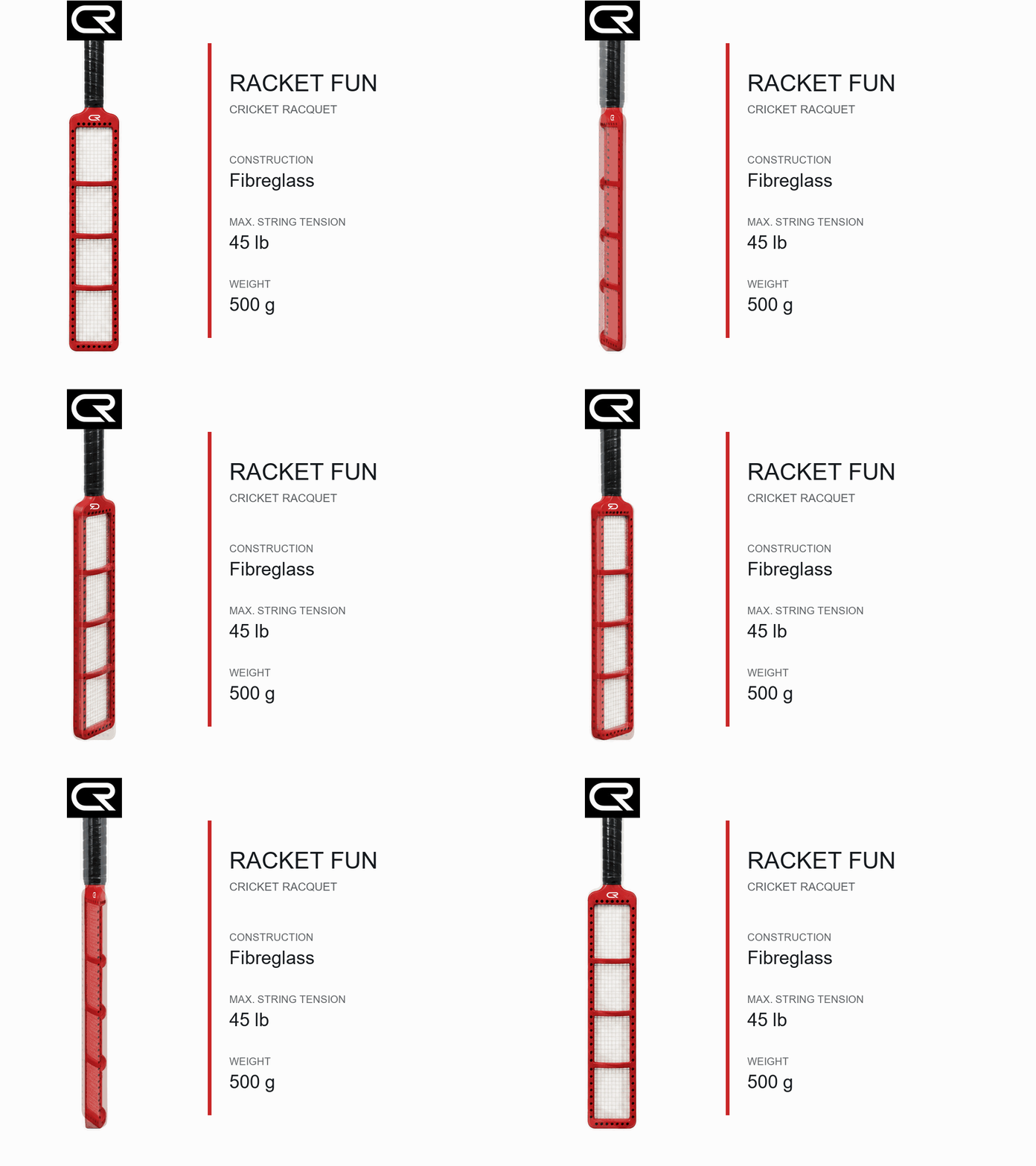
Cricket Racquet Fun (Adult)
Fibreglass · 500g · 45 Lbs max tension · Ideal for beach & backyard cricket
Carbon-fibre vs fibreglass — which frame?
The two frames share the same dimensions, but the carbon-fibre PRO is 430 g and the fibreglass FUN is 500 g — carbon is 70 g, or 14%, lighter. Neither automatically produces the faster or more accurate shot; the trade-off is between acceleration and effective mass at impact.
| Characteristic | Carbon-fibre PRO — 430 g | Fibreglass FUN — 500 g |
|---|---|---|
| Starting and adjusting the swing | Potentially easier to accelerate and reposition | Potentially requires more effort |
| Maximum swing speed | May allow a faster swing, particularly for players who struggle with heavier equipment | May limit swing speed for some players |
| Resistance to recoil | Lower mass may allow more backward movement at impact | Higher effective mass can resist recoil |
| Off-centre stability | Depends on how weight is distributed around the frame | Could resist twisting better if the extra weight is positioned appropriately |
| Frame flex | Could be stiffer despite weighing less; requires measurement | Could provide a more flexible response; requires measurement |
| String adjustment | Maximum 60 lb | Maximum 45 lb |
The weight-related benefits depend on swingweight and balance, not just total grams. Two frames with identical outside dimensions can still distribute their weight differently. — Cross & Bower (2006) found swing speed depended strongly on rotational inertia; mass alone did not explain it.
For a player who finds the FUN difficult to move quickly, the lighter PRO could help them get into position, accelerate the face and make late adjustments. For someone who comfortably handles its weight, the FUN's additional mass could provide a steadier response when blocking or redirecting an incoming ball. That depends on weight distribution: extra weight near the handle does not provide the same impact benefit as weight around the hitting area.
The most useful next measurements are balance point, swingweight and rebound speed, using the same strings and tension in both frames. That separates the frame differences from the string-setting differences. so 'faster', 'more stable' and 'more powerful' can follow a comparison test rather than a guess.
The design principle
A striking surface can improve rebound when it stores impact energy efficiently and returns that energy before the ball separates. Simply making something more flexible isn't enough — it must recover quickly enough. The Cricket Racquet applies this principle by using a strung surface that captures and returns energy on every hit.
References
This page draws on three peer-reviewed and academic sources:
- 1
Cross, R., Lindsey, C. & Andruczyk, D. (2000). 'Laboratory testing of tennis strings.' Sports Engineering, 3, 219–230.
Read the source - 2
Cross, R. 'The physics of baseball.' University of Sydney — explanatory resource covering ball compression, bat vibration and energy return, including comparison with tennis strings.
Read the source - 3
Nathan, A. M., Russell, D. A. & Smith, L. V. (2004). 'The Physics of the Trampoline Effect in Baseball and Softball Bats.' The Engineering of Sport 5, Volume 2, 38–44.
Read the source
These findings support a general design principle. A specific claim such as 'returns more energy than a conventional bat' would need comparative testing of the product.
Sources on children's equipment
Three studies inform this section:
- 1
Kidokoro, S., Sonomoto, S. & Akagi, R. (2018). 'Ideal bat mass property and bat grip position to maximize the batting performance in youth baseball players.' Japanese Journal of Biomechanics in Sports and Exercise, 22(3).
Read the source - 2
Dancy, P. A. J. & Murphy, C. P. (2020). 'The effect of equipment modification on the performance of novice junior cricket batters.' Journal of Sports Sciences, 38(21), 2415–2422.
Read the source - 3
Buszard, T., Reid, M., Masters, R. & Farrow, D. (2016). 'Scaling the Equipment and Play Area in Children's Sport to improve Motor Skill Acquisition: A Systematic Review.' Research Quarterly for Exercise and Sport, 87(1), 63–75.
Read the source
These studies support giving children manageable, well-balanced equipment. Current evidence does not establish that a lighter bat alone makes a child a better adult batsman.
Sources on string tension
Three studies inform this section:
- 1
Bower, R. & Cross, R. (2005). 'String tension effects on tennis ball rebound speed and accuracy during playing conditions.' Journal of Sports Sciences, 23(7), 765–771.
Read the source - 2
Bower, R. & Cross, R. (2008). 'Elite player sensitivity to string tension in tennis.'
Read the source - 3
(2025). 'Effects of different tennis racket string tension on forehand stroke effect and racket dynamic impact.'
Read the source
These tennis studies support the design principle of tuning rebound by tension. Their exact speed and control results cannot be assumed to apply to a cricket ball and this bat, and material names alone do not set safe tension limits — those come from manufacturer specifications and testing.
See how this plays on the field.
Shop the Cricket Racquet